
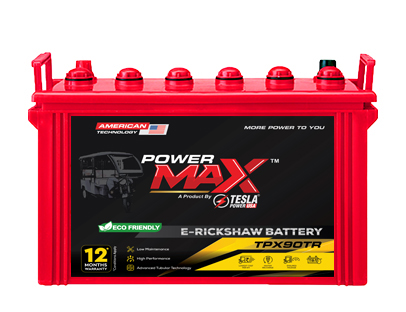
Power Max E-Rickshaw Batteries
Purpose-built deep-cycle batteries for electric rickshaws - delivering consistent power, rapid recovery, and maximum mileage per charge.
The Battery That Works as Hard as You Do
Electric three-wheelers are the backbone of last-mile mobility across India and emerging markets. Every hour of downtime is lost income. Every weak charge is a shorter route. Tesla Power Energy's Power Max E-Rickshaw Battery is engineered around one simple truth - e-rickshaw drivers can't afford to stop.
Built to meet the relentless demands of commercial e-rickshaw operations, Power Max delivers consistent power output, ultra-low maintenance, and a long operational life that keeps drivers on the road and earning - shift after shift.
See It From Every Angle.


Why Power Max?
Ultra-Low Maintenance
No frequent water top-ups. No complicated upkeep. Designed for hassle-free daily operation so drivers spend their time earning, not servicing.
Extended Battery Life
Built for deep cycling applications, delivers longer operational hours per charge - more kilometers, more passengers, and more income every day.
Fast Charging & High Efficiency
Rapid charging capability minimises downtime between shifts. Charge faster, hit the road sooner, and maximise your daily mileage.
High Corrosion Resistance
Engineered with high corrosion resistance to withstand heat, humidity, dust, and constant vibration without degrading performance.
Consistent Power Output
Stable energy delivery means smooth acceleration, reliable starts, and no unexpected power drops on busy streets or long routes.
Improved Safety & Spill-Proof
Built to the highest safety standards with spill-proof, sealed construction - protecting both driver and vehicle, every trip.
Why Tubular Plates Survive Deep Cycling.
Active Material Held in Tubes
In a tubular plate the positive active material sits inside woven tubes instead of being pasted flat onto a grid. Deep discharge makes that material expand and contract, and in a flat-plate battery it gradually sheds to the bottom of the case. The tube physically contains it.
Built for Discharge, Not Just Starting
A car battery gives a huge burst for a few seconds and is recharged immediately. An e-rickshaw pack is drawn down steadily for hours and refilled every night. Those are different jobs, and Power Max is designed for the second one — extended deep discharge, repeated daily.
Corrosion Resistance in Heat
Heat accelerates grid corrosion, and a battery charging in an enclosed yard after a full shift runs hot. High corrosion resistance is what keeps capacity from falling away over a season in hot, humid, dusty operating conditions.
Sealed and Spill-Proof
Batteries mounted under a passenger bench take constant vibration and are handled during swaps. Sealed spill-proof construction protects the driver and the vehicle, and removes the routine water top-ups that cost operators working hours.
Technical Details.
Built for Indian Roads.
City Traffic
Stop-start driving patterns that demand consistent deep cycling performance without battery degradation.
Rough Terrain
Vibration-resistant construction that holds up on uneven roads, potholes, and rural routes.
Extreme Temperatures
Thermal resilience ensures stable performance in sweltering summers and cold winters alike.
Long Daily Shifts
High cycle life means the battery keeps performing across full commercial workdays.
Maximum Value. Every Kilometre.
Getting Every Kilometre From a Charge.
Battery design sets the ceiling; daily habits decide how close an operator gets to it. These are the practices that most affect service life in commercial e-rickshaw use — worth passing on at the point of sale.
Avoid Deep Over-Discharge
Running the pack until the vehicle visibly slows is the fastest way to shorten its life. Planning routes so charging happens before that point costs a little range on the day and returns many months of service.
Charge Fully, Every Night
A lead-acid battery left part-charged sulfates and loses capacity permanently. Completing a full charge after each working day, rather than a partial top-up, is the single most valuable habit an operator can build.
Keep the Set Matched
E-rickshaws run several batteries in series. Replacing just one in an ageing set means the new unit is dragged down by the weaker ones. Keep every battery in a set the same age and rating, and replace them together.
Use the Matched Charger
A charger with the wrong voltage profile will either undercharge — leaving the pack short of full — or overcharge and cook it. Using the charger specified for the battery set protects the investment on both sides.
Charge Cool and Ventilated
Charging generates heat, and heat accelerates ageing. Letting batteries cool after a shift and charging in a ventilated space rather than a closed shed measurably extends life in hot climates.
Keep Terminals Clean and Tight
Corroded or loose terminals add resistance across a series set, wasting energy as heat and reducing range. A quick clean and a firm connection at each service recovers performance that is easily mistaken for a failing battery.
Industries & Applications.
Commercial E-Rickshaw Operators
Individual drivers and small fleet owners
E-Rickshaw Fleet Managers
Multi-vehicle operators needing consistent, scalable power
Last-Mile Delivery Services
Businesses dependent on electric three-wheelers for urban logistics
Passenger Transport
Shared mobility operators in tier-2 and tier-3 cities
Tesla Power Energy's Promise.
Download Brochures
Detailed product specifications, compliance data and technical drawings.
Common Questions
Power Max Batteries, Answered.
Tubular construction, deep-cycle duty, charging practice and distribution — the questions operators and trade buyers ask most about the Power Max range.
What is a tubular battery, and why is it used in e-rickshaws?
In a tubular battery the positive active material is held inside woven tubes rather than pasted flat onto a grid. That construction stops the material shedding during repeated deep discharge, which is exactly what an e-rickshaw does every working day. It is the reason tubular designs last far longer than flat-plate batteries in deep-cycle service, and why Power Max uses one.
What is the difference between a deep-cycle battery and a starting battery?
A starting battery delivers a very large current for a few seconds, then is immediately recharged — it is never meant to be run down. A deep-cycle battery like Power Max is built to be discharged substantially and recharged again, hundreds of times over. Using a starting battery in an e-rickshaw will fail within months; using a deep-cycle battery is what makes daily commercial duty viable.
Which Ah rating should an operator choose?
Power Max is offered in multiple Ah ratings. Higher amp-hour capacity means more energy stored and more kilometres between charges, at greater weight and cost. Match the rating to the vehicle's controller and motor specification and to the daily route length — operators running long shifts benefit from a higher rating, while short urban routes may not need it. The Tesla Power USA team can advise per market.
How should an e-rickshaw battery be charged to maximise life?
Charge fully after each working day rather than leaving the set part-charged overnight, and avoid running the pack down to the point where the vehicle slows noticeably — deep over-discharge shortens life faster than anything else. Use the charger matched to the battery set, keep the batteries cool and ventilated while charging, and keep all batteries in a set at the same age and rating.
Why do e-rickshaw batteries fail early?
The usual causes are habitual over-discharge, mismatched or ageing batteries within one set, an unsuitable charger, and heat with poor ventilation. Power Max addresses the hardware side with tubular plates, corrosion resistance and sealed spill-proof construction, but charging discipline is what determines how much of that design life an operator actually realises.
Can I distribute Power Max e-rickshaw batteries in my country?
Yes. Tesla Power USA appoints distributors, wholesalers and importers by territory, with West Africa and East Africa currently prioritised — both regions with fast-growing electric three-wheeler and last-mile delivery demand. Fleet and bulk enquiries are handled by the regional team.
Explore the range
- LiON Max LiFePO4 lithium batteries
- Inverto Max inverter tubular batteries
- Solar Max solar tubular batteries
- Dyno Pro two-wheeler batteries
Trade buyers can review distributor partnership terms, register a warranty, or contact the regional team.
Ready to Upgrade?
Join the thousands of e-rickshaw operators who've switched to Power Max - and never looked back.
For product enquiries, dealer partnerships, or bulk orders:
support@tpuenergy.com
Support Hours: Monday – Friday | 9 AM – 6 PM